
Caring for AMIRI Denim, Leather and Knitwear
A qualification belongs at the front: the research behind this guide surfaced no brand-published care manual that covers these materials as a group. Garment-level instructions do exist on individual product pages and on the tags, and they are quoted further down, yet the brand publishes nothing broad on looking after amiri clothing over years. The rest of what follows is plain material practice: workshop knowledge that applies equally to any hand-finished denim, any ovine or calf leather and any heavy cotton jersey. The distinction is worth holding onto, since a lot of the care writing about this label repackages general advice as house instruction. Searches for amiri jeans, amiri hoodie and amiri men are the usual prelude to care questions, and the volume jumps when people buy amiri online without seeing a tag first. Where the care label contradicts this article, the label takes precedence.
What the Care Labels Actually Say
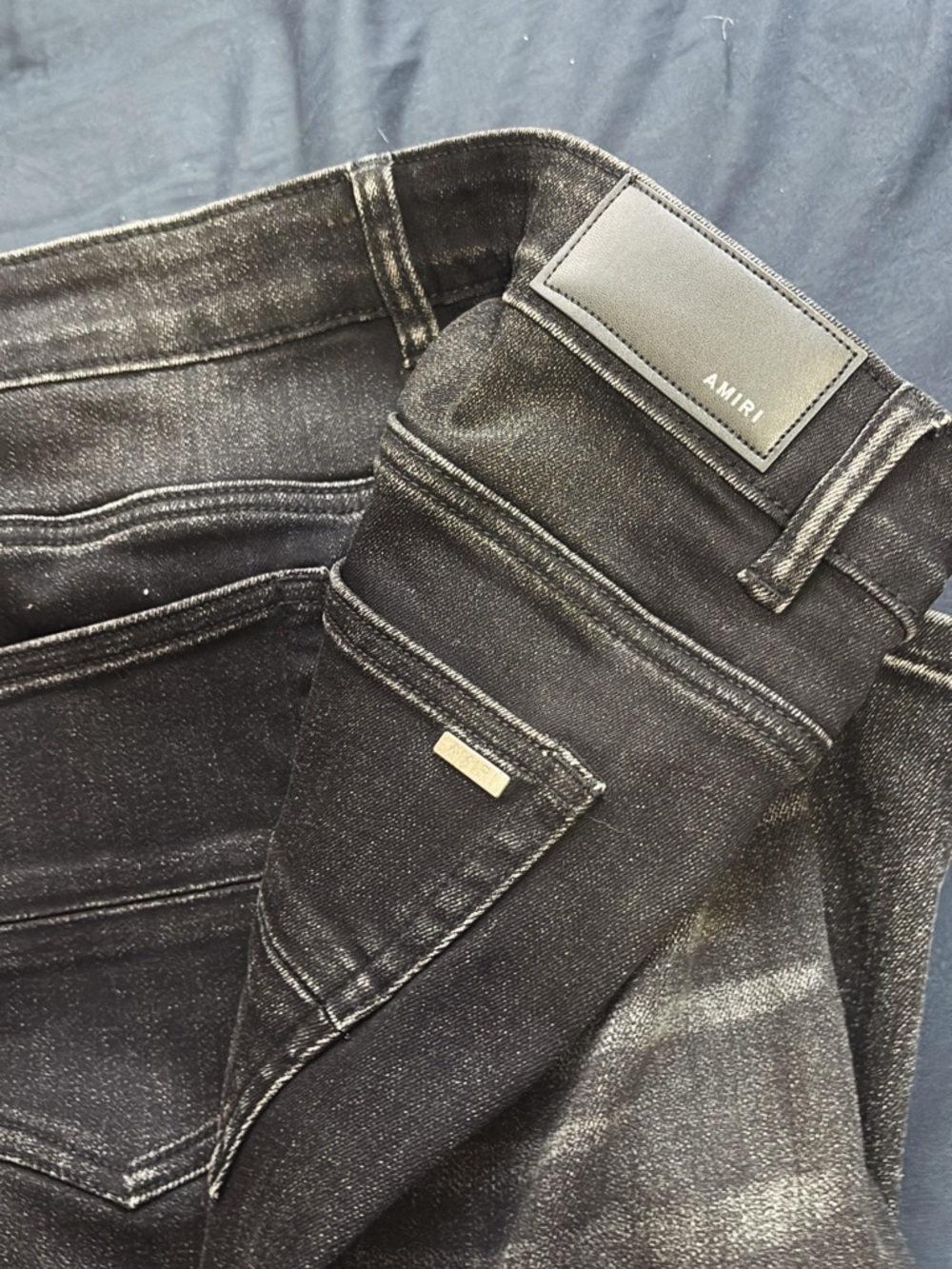
Instructions on the core products run unusually strict, and the time to read them is before the first wear, not after the first accident. An explicit special-process warning attaches to core denim, noting intentional shading variation and possible dye transfer onto lighter surfaces. That denim is designated spot-clean only, with washing, bleaching, tumble drying, ironing and dry cleaning all struck off. Core jersey pieces go in the opposite direction and call for professional dry cleaning instead of home laundering. Both instructions sit at odds with how most people treat jeans and sweatshirts, which is exactly why they get ignored. Composition matters too, since core denim runs at ninety-two percent cotton with six percent elastomultiester and two percent elastane, and elastane degrades in heat.
- Core denim: spot clean and nothing more, amiri so no washing, no bleach, no dryer, no iron and no dry cleaning
- Core denim: the shading variation is intended, and dye transfer can happen
- Core jersey: professional dry cleaning
About the Denim: the Distressing Is the Product
The central idea is that the damage you are looking at is the design rather than a fault. The jeans are hand-distressed and then repaired visibly, most famously on the MX1, where pleated ovine leather is worked into the abraded areas at knee and thigh. Anything that homogenises the surface, whether a hot wash, a tumble dryer or an aggressive commercial cleaner, erodes the thing you paid for. The frayed edges on a Shotgun are supposed to read as blown out and sanded, while the long inseam on a Stack is supposed to concertina over a sneaker. Both are intentional, so no tailor operating on autopilot should be allowed to correct them. Wear should keep developing from use rather than from laundering, so rest a pair for a day between wears and the shape recovers on its own.
Treating Hand-Distressed amiri jeans
Spot cleaning means you treat the mark rather than the garment, and it is less satisfying and slower than any alternative. Work inwards from the outside of a stain with a barely damp cloth and cold water, blotting rather than rubbing. Keep water away from leather inserts, because the two materials dry at different rates and the join is where damage shows. Dry flat in the air, or on a broad hanger, clear of radiators and direct sun, because heat fixes both shrinkage and colour loss. Odour, usually the real reason people reach for a wash, responds better to airing and a distant pass of steam than to detergent. Deep indigo transfers onto pale upholstery and light sneakers, so give a new pair a few careful wears before trusting it near either.
Inserts, Hardware and Stud Fields
Hardware and contrast panels are the parts most likely to need attention, and early intervention is always cheapest. On genuine pieces the rear leather patches, buttons and rivets are substantial and securely set, so any looseness is a call for repair, not a characteristic. Feed a dried-out leather insert with a small amount of neutral conditioner, keeping it to the panel, then buff it off before it migrates onto the denim. Secure loose threads at a repaired seam and leave the pulling alone: one tug is enough to open a run through inches of hand-finished work. In structural terms Bandana and jacquard panels do the same job leather does elsewhere in the line, which means treating a printed panel with equal caution. Studs and crystal settings want checking every few wears, since they are what catches on car seats and chair arms.
Leather Boots, Jackets and the Uppers on Sneakers
There are three separate roles for leather in this line, and no two of them take the same treatment. Boots like the Ryder, observed at $1,090 in leather, $1,190 in suede and $1,290 in a python-embossed finish, want conventional boot care: brush them down after wear, condition sparingly, use trees. The exception is suede, which wants a brush and an eraser rather than cream, and which wants protecting before the first wear instead of rescued after the fact. On the Skel-Top Low the uppers are leather over a rubber sole, so a damp cloth and a soft brush see off nearly everything that a machine wash would destroy. The bone appliqués there are hand-cut and outlined in contrast topstitching, which means scrubbing lifts the stitch line before it lifts the dirt. Whatever the leather, dry it gradually, at room temperature, nowhere near any heat source.
Jersey and Knitwear
Hoodies and tees are where the gap between the tag and everyday habits is greatest. Core jersey specifies professional dry cleaning, and the MA Core Logo Hoodie is entirely cotton and made in the United States, so it will shrink and distort if it meets heat. If you launder a jersey piece at home against the tag, cold water, inside out, a gentle cycle and no dryer is the least destructive route available. Applied graphics, chenille patches and embroidery are the earliest casualties, and what breaks them down is friction and heat, not soap. A hanger is the wrong choice for drying: a soaked heavy hoodie will stretch through the shoulders under its own weight, so lay it flat. Both fleece and knit develop pills as they are worn, and a comb or fabric shaver, used gently, restores the surface without thinning it.
Storage, Rotation and Travel
Storage accounts for most of the damage that need not happen, and it is free to fix. Denim goes on a clip hanger by the waistband, or folds along existing creases; either way, repaired panels must not be bent over a bar. Dark and light pieces should be kept apart, since the dye transfer warning on core denim applies to whatever hangs beside it. Give leather air and space, since a compressed garment bag traps moisture against the surface and encourages mould in humid climates. Wearing one pair every day is the mistake; rotate them, since fibres with elastane content need time to spring back. For travel, roll jersey, fold denim, and carry footwear in a bag that keeps the sole away from everything else.
Quick Reference and the Point of Calling a Professional
The table condenses everything above into the shortest usable form, naming the material, the instruction that carries the most weight, and the mistake that does the most damage. Wherever the brand’s own tag gives an instruction, it overrides the general practice listed here. None of these are laboratory results and none come from a brand-published care manual, because no such manual was found. They are the careful options, and with hand-finished garments that is usually the right bias.
| Material type | Primary instruction | Commonest error |
|---|---|---|
| Core denim with distressing | Spot clean only, cold, air dry | Machine wash, or the dryer |
| Leather inserts on denim | Condition the panel on its own and keep it dry | Getting the panel wet with the garment |
| Cotton core jersey | Professional dry cleaning per the tag | Hot washing and hanging it while still wet |
| Smooth leather and suede | Brush and shape; cream on smooth only | Conditioner on suede, or drying beside a heat source |
| Sneaker uppers in leather | A damp cloth with a soft brush | Putting them through a machine |
There is a point at which doing nothing is the skilled response. Structural damage through a repaired panel, a torn leather insert, a failed seam under a stud field, or a stain set into distressed denim all belong with a specialist, as does anything involving solvent, dye or heat. The brand does offer after-sales service and repairs, but the terms are narrow: assistance is handled case by case, applies to products purchased from its own site, and repair fees can apply. If the purchase was secondhand, the answer is a private specialist, and any good denim or leather atelier will quote before working. Clean it less, air it more, repair it early, and keep heat away from all of it.